
Thinking
welcome to the conceptual foundations of pluriversal futures.
This section offers an entry point into the ideas that inspire our work toward imagining otherwise. Perhaps you feel disheartened watching the modern world unravel. For many, it is like being passengers on a metaphorical Titanic, a vessel whose course was set generations ago. The Pluriverse reminds us that this ship is not the whole world—it is only one trajectory, not the inevitable future we’ve been led to believe.
None of this thinking begins with us. It is rooted in the struggles, wisdom, and creativity of communities, authors, and cultures who have long imagined and defended different ways of being—often at great cost. Their work makes it possible for us to glimpse other futures, and we honor them as the ground on which the Pluriversal Futures Design Lab stands.
What is the pluriverse?
The concept of the pluriverse is about making visible ways of being and knowledge-systems that recognize human interdependence with the biosphere.
Often defined as “a world where many worlds fit,” the pluriverse is the idea that multiple ways of knowing, being, and world-making can coexist. Rooted in the Zapatista movement and brought into design discourse by Arturo Escobar, the pluriverse challenges the belief that we all inhabit a 'single world' with the Global North as its center and ideal expression.
The pluriverse asks us to recognize that how each world interacts with the planet Earth depends on its cosmovision or ontology—the shared narratives, frameworks, and practices used to make sense of life. It pays particular attention to the distinction between the ontology that has created the modern world — based on the separation of humans from nature and the metaphor of the planet as a machine — and the numerous cosmovisions that understand the planet as a living whole and humans as an integral part of an entangled web of life.

why pluriversal futures?
The concept of the Pluriverse challenges the belief in a singular path of progress, where diverse societies are expected to converge into the one singular future envisioned by modern civilization. Our lab believes that pluriversality is about crafting different destinies and nurturing multiple trajectories.
A key part of this is recognizing the various ways societies envision the "good life"—from the American Dream to Buen Vivir—and the practices and strategies used to realize these ideals. Every form of world-building is shaped by collective visions and assumptions.
How do you understand the concepts of future, innovation, tradition, and modernity? Delving into these ideas is crucial for designing pluriversal futures.
“Every vision of what life is constructs a world.
In fact, that is what the cosmovision concept means. This applies as much to the cosmovisions of ethnic groups as it does to the dominant cosmovision of modernity, European in origin, even if modernity is considered the true or most accurate way to think and thus to exist.
Every vision of the world is based on a series of implicit premises, arises from particular histories, and has implications for the sort of world it constructs.”
— Arturo Escobar, 2020
what do we mean by worlds?
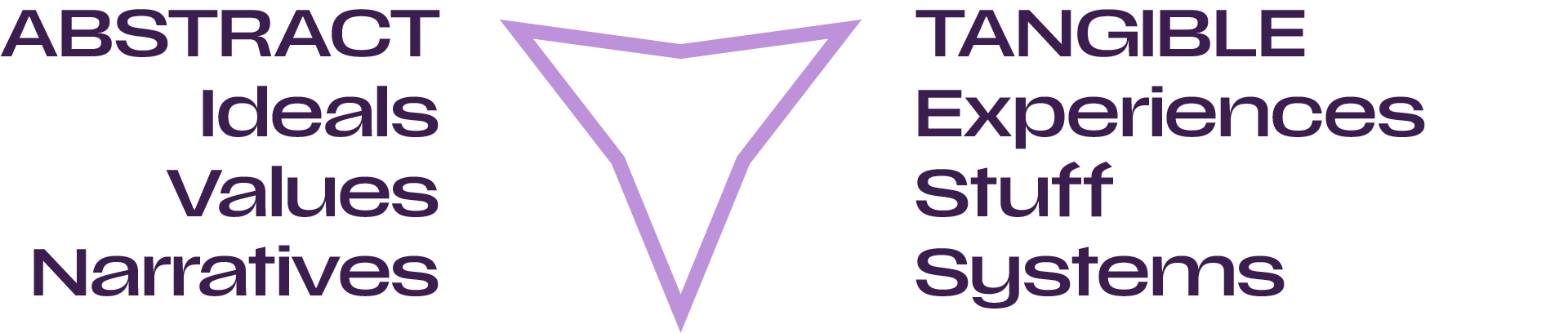
Worlds are not merely external realities. They are constructed through the interplay between the ideas humans hold (a matrix of meaning) and the ways in which we shape our tangible surroundings (design). In essence, worlds are created through the interaction between the immaterial (ontologies, cosmovisions, paradigms, ideals) and the material (objects, bodies, nature).
Worlds can also be understood as collective meta-narratives that provide meaning and direction to life. These meta-narratives that shape worlds include beliefs, myths, and metaphors.
“For instance, consider your preferred metaphor for the planet: Is it a web of life, Mother Earth, or a machine?”
Modernity—the globalized world most humans inhabit—is based on interpreting the planet as a machine to be controlled and exploited. This mechanistic view facilitates the reckless extraction and wastefulness that are currently destroying the conditions necessary for sustaining life. Other narratives are possible. Other metaphors are possible.
We dump approximately 8 million tons of plastic waste into the oceans every year. Pause for a moment and imagine how different our world-making practices would be if we viewed the oceans as life-givers, deserving of respect and reverence.
design is form-giving and world-building
Design is the activity that connects the immaterial and the material aspects of our worlds. It is about giving form to what a society envisions as ideal and desirable. What is the tangible form of happiness? A house with a white picket fence? A community garden where we play, sing, and dance together? A luscious green forest?
Through design, we reshape the physical world to conform to our ideals. However, this is a two-way relationship: the environments we design have the power to shape what we, in turn, envision as possible or desirable.
While world-building is a universal human practice, the "design" profession as we know it emerged with the Industrial Revolution. Design became the field dedicated to conceiving products for mass reproduction—the activity that gave tangible shape to the ideals of modernity.
People have increasingly perceived themselves as detached from nature, living in progressively artificial environments. Within the matrix of meaning of modernity, many came to believe that greater artificiality and distancing ourselves from the web of life represented "progress." This artificial modern world had to be designed: from our buildings and cars to our gadgets and fashion.
modernity
Modernity can be understood as a metaphorical Titanic. We were led to believe it was the finest ship ever built, destined for a promised land where all problems would be solved. While its foundations were laid over centuries—shaped by the Scientific Revolution, the colonization of the Americas, the Enlightenment, and the Industrial Revolution—it was after World War II that modernity became a totalizing global project. Every inhabitant of Earth was expected to board this glorious ship to "evolve" or become "developed."
The defining features of this ship are:
• The belief in progress as a linear, unidirectional path.
• The perceived separation between humans and nature.
Essentially, modernity refers to a world created by humans who ignore our interdependence with the biosphere. It acts as a monoculture of meaning, asserting itself as the only correct way to live. In this unilinear narrative, every society is destined to eventually be included in this single storyline, dividing the planet into those who follow the template ("developed") and those who do not yet follow it satisfactorily ("developing"). This linearity is mirrored in our systems of extraction, production, and disposal.
Because modernity fails to acknowledge our interdependence with the biosphere, it envisions the human future as separate from the planet’s future. This is evident even in the phrase "Save the planet!" The planet has endured five mass extinctions before; it can survive another. We cannot. The conditions necessary to sustain human life are intricately linked to Earth’s web of life.
the polycrisis of modernity
The pluriverse emerged as a response to the worsening "polycrisis"—the interconnected crises of climate, energy, inequality, impoverishment, migration, authoritarianism, and meaning — as well as to the inability of modern civilization to respond effectively to them. Between 2018 and 2024 alone, the global economy consumed nearly as many virgin materials as it did throughout the entire 20th century.
In our Titanic metaphor, the captain received news of the icebergs ahead in the 1970s. Yet, instead of changing course, the ship has only picked up speed. Initially, those in first class believed the water would reach the lower decks long before it affected them. They assumed that by the time the water reached their level, a technological fix would save them, or they could simply board a spaceship and move to Mars.
“The pluriverse works from the premise that we cannot find a way out of this polycrisis using the same ontology of separation that created it.”
It is only through contact with other-than-modern cosmovisions that different ways of thinking and being can come to light.
invisible other-than-modern worlds
While modernity views humans as separate from nature, numerous cosmovisions understand humans as part of a larger entity—Mother Earth, Anima Mundi, or the interconnected web of life—deserving of reverence. Because these systems of meaning have been erased or ridiculed by modernity as "primitive," pluriversality involves making visible the meaning and knowledge systems of peoples who recognize the planet as a living entity.
Modernity is built on the myth that it constitutes the one and only rational way to think about life. It promotes the notion that the only rational way to live involves exploiting and destroying ecosystems to produce quickly discarded products, generating vast amounts of toxic waste. This is deemed rational, while any way of thinking that recognizes our interdependence with the web of life is considered irrational.
Pluriversal Futures is an affirmation that we can embrace an alternative meta-narrative.
We can harness our intelligence, creativity, and technology to build worlds that reflect our responsibility and interdependence with the web of life.
inspiration
scholars
The conceptual foundations of Pluriversal Futures are built upon the wisdom of scholars across decolonial thought, design, Indigenous thought, systems thinking, and cognitive science. While our work is a collective tapestry, the following authors have been instrumental in shaping our thinking.
-
Escobar’s work is the primary influence on our lab, providing the framework through which we understand the pluriverse.
Pluriversal Politics: The Real and the Possible (2020)
Designs for the Pluriverse: Radical Interdependence, Autonomy, and the Making of Worlds (2018)
Encountering Development: The Making and Unmaking of the Third World (2011)
-
Vanessa’s work is a vital influence on our use of metaphors and visual storytelling. Her research offers profound insights into how we might face the end of the modern world with integrity and how we can "braid" different ways of knowing.
Hospicing Modernity: Facing Humanity's Wrongs and the Implications for Social Activism (2021)
Towards Braiding (2019) – with Elwood Jimmy and Sharon Stein
-
Blaser’s work is fundamental to our understanding of "ontological politics" and the ways in which different worlds conflict and coexist.
On the properly political (disposition for the) Anthropocene (2019)
A World of Many Worlds (2018) – co-edited with Marisol de la Cadena
In the Way of Development: Indigenous Peoples, Life Projects and Globalization (2004)
-
De la Cadena’s work is essential to our understanding of how non-human entities—such as mountains, water, and forests—are active participants in the social and political life of many worlds.
Earth Beings: Ecologies of Practice across Andean Worlds (2015)
A World of Many Worlds (2018) — co-edited with Mario Blaser
-
Ahenakew’s work offers an Indigenous-centered perspective on the difficulties of translating Indigenous knowledges into non-Indigenous languages. He invites us to move beyond the "illusion of separability" that has fractured our sense of entanglement with the cosmos, the earth, other species, and with each other.
Towards Scarring Our Collective Soul Wound (2019)
“we need to re-centre the earth in our individual and collective existence in order to re-activate our sense of entangled relationality that will show us that we are interwoven in (rather than with) each other through the metabolism of the land… Centring the land is not about centring the concept of the land, but about centring the land as a metabolism.” (p. 15)